Compliance Training Generated From Your Policy
Circulating a policy PDF proves people received it. Generating the training from that same policy - with comprehension checks and completion records - proves they understood it. Same source document, far stronger evidence.
- Training generated from the approved policy itself
- Comprehension checks instead of a signature
- Dated completion records per person
- Re-issue in minutes when the policy is revised
No credit card. No implementation project. Last updated August 2026.
Short answer
How do you turn a policy into compliance training?
Generate the course directly from the approved policy document rather than from a summary, so the training can never contradict the policy. The AI splits the policy into sections and writes comprehension questions on the obligations that carry consequences - reporting timelines, prohibited actions, escalation paths. You assign one course per policy and keep the dated completion records as your acknowledgment trail, re-issuing the course whenever the policy is revised.
- One course per policy, never a merged 'compliance' bundle
- Comprehension checks are stronger evidence than signatures
- Regenerate and re-assign on every policy revision
- Not legal advice - have your compliance owner review first
At a glance
- Input
- The approved policy document (PDF, Word, or a policy page URL)
- Output
- Policy course with sections, summary and comprehension questions
- Evidence produced
- Per-person completion records plus knowledge check results
- Best practice
- One course per policy, re-issued on every policy revision
- Common first policy
- Information security and acceptable use
- Important caveat
- Not legal advice - have your compliance owner review before assigning
Workflow
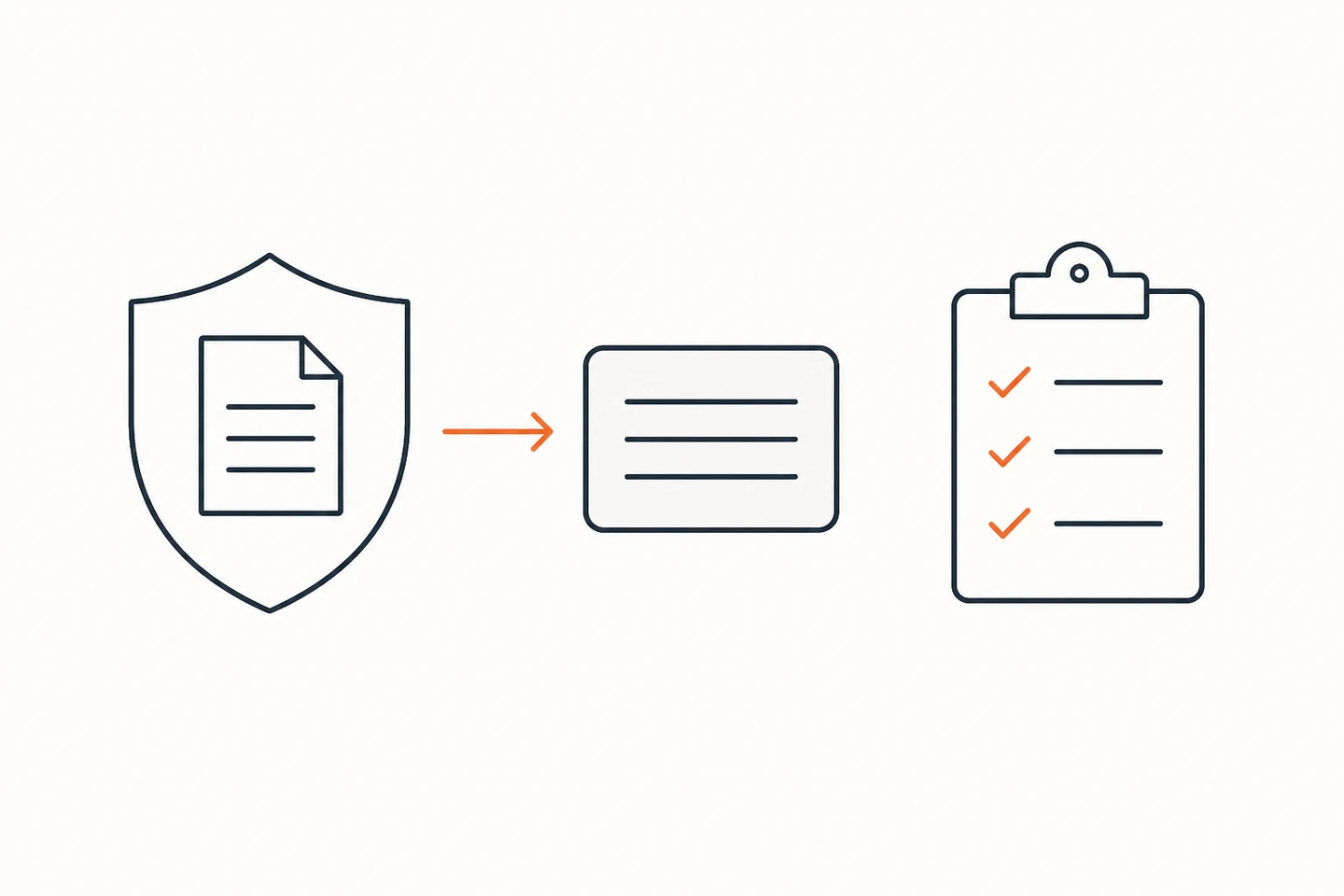
Policy to trained, documented team
- 01
Upload the policy as the single source
Generate the training from the approved policy document itself, not from a summary of it. That way the course can never say something the policy does not.
- 02
Generate lessons plus knowledge checks
Lorea structures the policy into readable sections and produces questions on the parts that matter - reporting timelines, prohibited actions, escalation paths.
- 03
Assign, then keep the completion record
Completion plus correct answers is a far stronger acknowledgment trail than a signature confirming somebody received a PDF.
Policy types
Policies worth converting into training
Ranked roughly by how expensive a misunderstanding is. Start at the top.
Information security and acceptable use
Password and MFA rules, device handling, shadow IT, phishing reporting. Usually the highest-value policy to convert first because the failure mode is expensive.
Data protection and privacy
GDPR and equivalent obligations, data subject requests, retention rules, what may be pasted into third-party tools - including AI tools.
Health, safety and site rules
Site inductions, equipment handling, incident reporting. Knowledge checks matter most where a misunderstanding causes physical harm.
Code of conduct and anti-harassment
Expected behaviour, reporting channels and what happens after a report. Comprehension here is the point; a signature proves nothing.
Finance, procurement and anti-bribery
Approval thresholds, gifts and hospitality, supplier due diligence, expense rules - the areas where people improvise when the policy is unclear.
Client and contractual obligations
Confidentiality terms, data handling commitments in customer contracts, and the internal rules that follow from them.
Five rules for defensible policy training
What separates a real acknowledgment trail from a folder of signed PDFs.
- 1
Keep one course per policy
A single 'Compliance 2026' course produces a completion record that proves nothing specific. One course per policy means you can show exactly which obligation each person was trained on and when.
- 2
Test comprehension, not attendance
An acknowledgment signature demonstrates receipt. A passed knowledge check demonstrates understanding. If a regulator or customer ever asks what your training achieved, only one of those is an answer.
- 3
Version the training with the policy
When the policy is revised, regenerate the course and re-assign it. Keep the old completion records - they show what people were trained on under the previous version, which is exactly what an audit asks for.
- 4
Write questions about real decisions
'What is the reporting deadline?' is fine. 'You notice a colleague has emailed a customer list to their personal address - what do you do?' is better, because it tests the behaviour the policy exists to change.
- 5
Do not treat this as legal advice
The tool generates training from your policy; it does not tell you what your obligations are. If a specific framework governs you, have counsel or your compliance lead review the policy and the generated course before you assign it.
Signatures prove receipt, not understanding
Which is a problem, because the whole point of a policy is to change behaviour.
The standard small-company approach to compliance is to email the policy, collect an acknowledgment, and file it. It is fast, and it produces a paper trail - but the trail only ever demonstrates that a document was delivered. If somebody later pastes customer data into an unapproved tool, a signature on the acceptable use policy does not tell you whether the rule was unclear, unread, or ignored.
Policy acknowledgment training closes that gap by adding one thing: questions. When someone has to answer what the reporting deadline is, or what to do when a colleague forwards a customer list to a personal address, you learn whether the policy actually transferred. And when the same question is missed by most of the team, you have learned something more useful - the policy is written badly.
Why generating from the policy matters
Compliance training bought off the shelf teaches generic good practice. Compliance training generated from your policy teaches your rules - your thresholds, your reporting channels, your named systems. That specificity is the difference between training people find abstract and training they can act on. It also removes the drift problem: since the course is regenerated from the policy file, there is no second document to fall out of date.
Keep the records granular
Resist the urge to bundle everything into one annual compliance course. Granular records - this person completed the information security policy course on this date, under this policy version - answer audit questions directly. A single combined completion tells you almost nothing when someone asks which obligation was covered.
Where this fits with the rest of your training
Keep compliance separate from general onboarding training so the completion trail stays clean, even if both are assigned in week one. Operational procedures belong in SOP training. If your policy is a long PDF with several distinct topics, split it using the guidance in PDF to training course. Teams weighing whether they need formal audit reporting should read LMS alternative for small business, which covers the point at which a compliance-focused LMS genuinely becomes the right purchase.
Frequently asked questions
How do I create compliance training from a policy document?
Upload the approved policy and generate a course directly from it, so the training and the policy share one source. The AI splits the policy into readable sections and produces comprehension questions on the obligations that matter - reporting timelines, prohibited actions, escalation paths. You then assign it and keep the completion records as your acknowledgment trail.
Is a completion record enough for policy acknowledgment?
For most internal and customer-driven requirements, a dated completion record plus knowledge check results is stronger evidence than a signature confirming someone received a PDF, because it shows comprehension rather than receipt. Whether it satisfies a specific regulatory framework depends on that framework - confirm with whoever owns compliance in your organisation.
What happens when the policy is updated?
Regenerate the course from the revised policy and re-assign it to everyone in scope. Keep the previous completion records rather than overwriting them: they document what people were trained on under the earlier version, which is what an audit trail is for.
Which policy should we convert first?
Usually information security and acceptable use. It applies to everyone, the failure mode is expensive, and it is the policy most likely to be circulated as a PDF and never read. Health and safety comes first instead if you have physical sites or equipment.
Can this replace a dedicated compliance training vendor?
For internal policies you wrote yourself, generating training from the policy is usually faster, cheaper and more accurate than generic off-the-shelf modules, because it trains people on your actual rules. For certified curricula in regulated industries - where an accredited provider or specific certification is required - you still need the specialist vendor.
Is this legal advice?
No. Lorea turns the policy you provide into training; it does not determine your legal obligations or validate that your policy is adequate. Have your compliance owner or legal counsel review both the policy and the generated course before assigning it.
Start with your security policy
Upload your acceptable use or information security policy and see the course and questions it produces. Have your compliance owner review before you assign it.
Build your first course - freeFree to start. No credit card, no implementation call.
More for teams