DNA → mRNA Transcription Tool
Transcribe a DNA sequence into mRNA instantly — or convert mRNA back to DNA. Choose coding or template strand. Free, no sign-up.
DNA to mRNA Converter · Transcribe DNA Sequence · Template or Coding Strand
0 bases · spaces and numbers are stripped, U is rejected
mRNA
Type a sequence and the mRNA appears here instantly.
How to Transcribe DNA into mRNA
Three choices. The sequence updates as you type.
Pick a direction
DNA → mRNA is transcription. mRNA → DNA is the reverse: useful when a problem gives you the transcript and asks for the gene.
Say which strand you have
Coding strand looks like the mRNA (T instead of U). Template strand is what RNA polymerase actually reads. Choosing the wrong one is the usual error.
Paste the sequence
A, T, G, C for DNA, or A, U, G, C for RNA. Spaces and numbers are stripped. The transcript updates as you type — copy it when you are done.
How is mRNA transcribed from DNA?
Transcription is the first step of protein synthesis: the cell copies a gene into a messenger RNA that can leave the nucleus. RNA polymerase binds the promoter, unwinds a short stretch of the double helix, and reads the template strand 3′ to 5′. The RNA it builds grows 5′ to 3′.
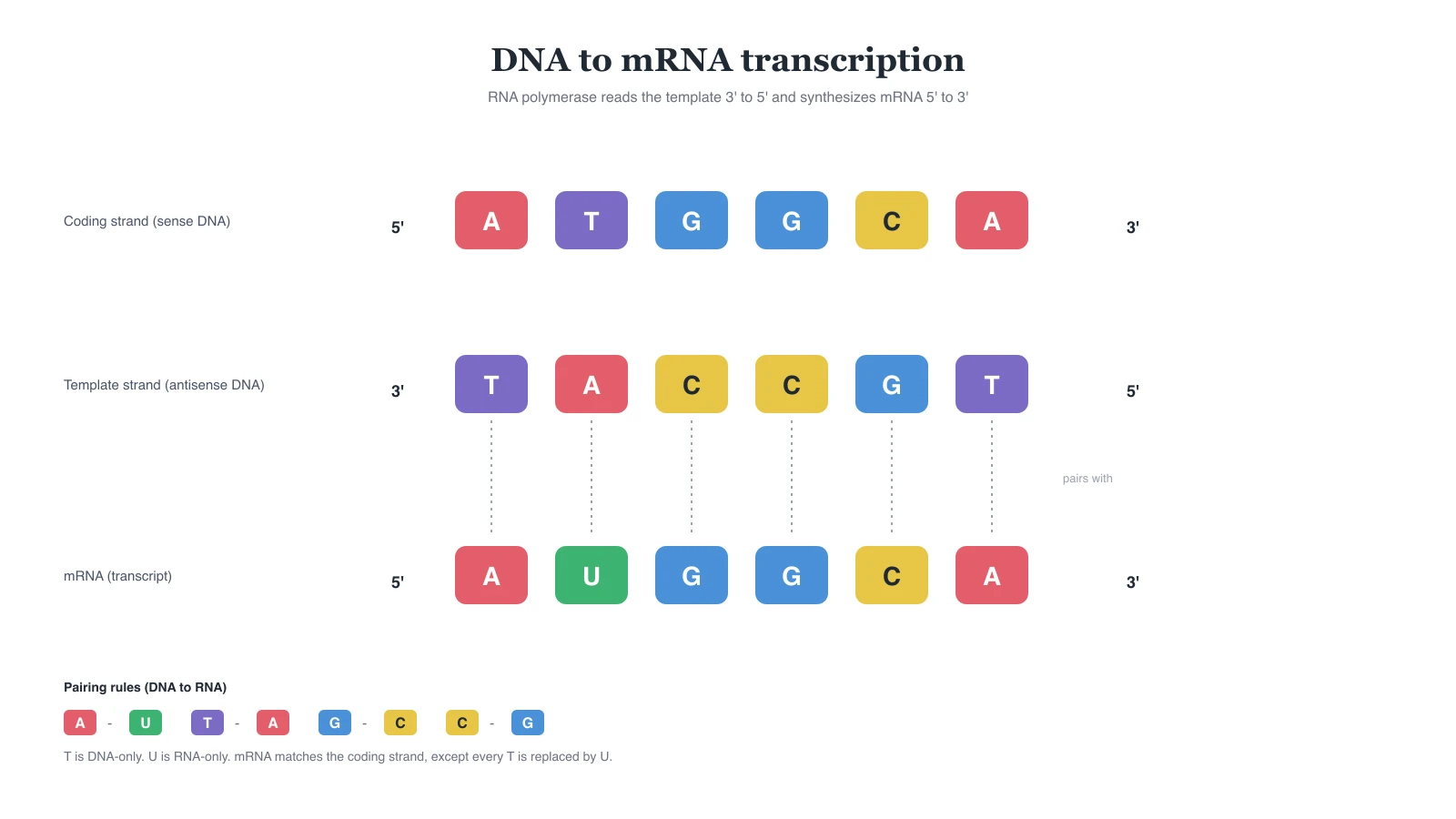
The pairing rules are the only thing you need to transcribe a sequence by hand — or to check this tool. DNA adenine pairs with RNA uracil, DNA thymine with RNA adenine, guanine with cytosine, cytosine with guanine. There is no T in RNA. That is why a coding-strand DNA sequence and its mRNA look the same except every T is a U.
Exam questions that say “transcribe this DNA sequence into mRNA” almost always want that base-for-base step, not the later eukaryotic processing (5′ cap, splicing, poly-A tail). This converter does the exam version: paste the sequence, say which strand it is, get the transcript.
DNA to RNA pairing rules
| DNA base | Pairs with (RNA) | Notes |
|---|---|---|
| A (adenine) | U (uracil) | Not T. This is the most common error. |
| T (thymine) | A (adenine) | T exists only in DNA. |
| G (guanine) | C (cytosine) | Same pairing as in DNA. |
| C (cytosine) | G (guanine) | Same pairing as in DNA. |
Worked example: transcribe a DNA sequence into mRNA
Coding 5′-ATGGCA-3′. Template is the reverse complement, 3′-TACCGT-5′. The mRNA is 5′-AUGGCA-3′ — same as the coding strand, T replaced by U.
| You pasted | Setting | mRNA (5′→3′) |
|---|---|---|
| ATGGCA | Coding strand | AUGGCA |
| TACCGT | Template strand | AUGGCA |
| TACGGA | Template strand | AUGCCU |
The third row is the standard textbook problem: template 3′-TACGGA-5′ produces 5′-AUGCCU-3′. Paste TACGGA, choose template, and the tool should match the transcription lesson.
Coding strand vs template strand
DNA is double-stranded. Only one strand is read. The template strand (antisense) is the one RNA polymerase tracks. The coding strand (sense) is the unused partner — unused for synthesis, but useful on paper, because its sequence is the mRNA with T in place of U.
That is why two settings exist. If you treat a template sequence as coding, you write T→U on the wrong letters and the whole transcript is the complement of the answer. If a problem does not say which strand it is, it is usually the coding strand. If it gives the sequence 3′ to 5′, it is usually the template.
| Feature | Template strand | Coding strand |
|---|---|---|
| Also called | Antisense | Sense |
| Read by RNA polymerase | Yes, 3′ to 5′ | No |
| Relation to mRNA | Complementary (A pairs with U) | Same sequence, T instead of U |
After transcription: read the codon sun
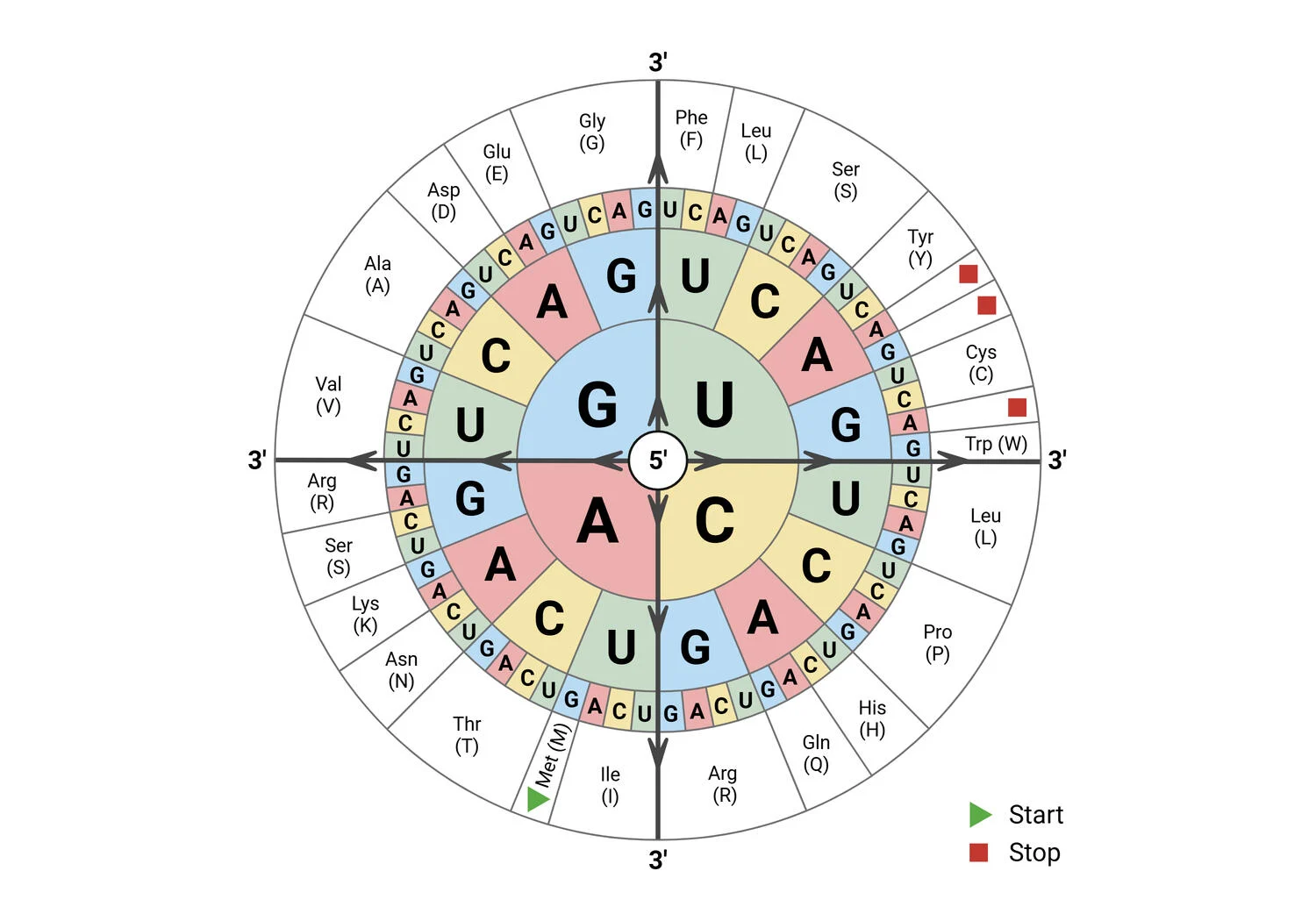
Transcription stops at mRNA. Translation reads that mRNA in triplets, 5′ to 3′. Start at the centre of the sun, first base, then second, then third. AUG is methionine and the start codon. UAA, UAG and UGA are stop. For the pathway around this step, see translation and the amino acid game.
Why students get this wrong
Almost every missed mark on “transcribe this DNA sequence into mRNA” is the same mistake: treating the template strand as if it were the coding strand, or writing T into the RNA. The coding strand looks like the mRNA. The template strand is the complement. This tool makes you say which one you have before it converts anything.
The other trap is direction. Sequences are written 5′ to 3′ unless a problem says otherwise. If a question gives you 3′-TACGGA-5′ as the template, paste TACGGA and choose template — the mRNA is 5′-AUGCCU-3′.
A third mistake is mixing transcription with translation. Transcribing a sequence does not produce an amino-acid chain. It produces RNA. You only start grouping bases into codons after you have the mRNA, which is what the codon sun is for.
Frequently Asked Questions
How do I transcribe a DNA sequence into mRNA?
Paste the DNA above and leave the direction on DNA → mRNA. If you pasted the coding (sense) strand, every T becomes U. If you pasted the template (antisense) strand, the tool takes the complement and writes U instead of T. The result is the 5′→3′ mRNA.
How is mRNA transcribed from DNA?
RNA polymerase binds a promoter, reads the template strand 3′ to 5′, and synthesizes a complementary RNA 5′ to 3′. Adenine on DNA pairs with uracil on RNA, thymine with adenine, guanine with cytosine, cytosine with guanine. The finished transcript matches the coding strand except that T is replaced by U.
What is the difference between the coding strand and the template strand?
RNA polymerase reads the template strand. The mRNA it builds is complementary to that template, and identical to the coding strand except T → U. Most homework sequences are the coding strand. If a problem says 'template' or gives DNA as 3′→5′, switch to template.
If the DNA template is 3′-TACGGA-5′, what is the mRNA?
5′-AUGCCU-3′. T pairs with A, A pairs with U (not T), C pairs with G, G pairs with C. Paste TACGGA, choose template strand, and you should see AUGCCU — the same worked example as in the transcription lesson.
How do I transcribe the DNA sequence into an mRNA transcript if I only have the coding strand?
Keep 'I pasted the coding strand' selected. The converter replaces T with U and leaves A, G and C unchanged. Coding 5′-ATGGCA-3′ becomes mRNA 5′-AUGGCA-3′.
Can I convert mRNA back to DNA?
Yes. Flip the direction to mRNA → DNA. Coding-strand output swaps U for T. Template-strand output is the complement of the mRNA, written with T.
Is this DNA to mRNA tool free?
Yes. It runs in your browser, no account, no upload, no limit on sequence length. Nothing is sent to a server.
Does this also translate mRNA into amino acids?
This page stops at transcription. After you have the mRNA, read it in triplets on the codon sun below, or continue with the protein synthesis course for translation.
Does the tool add a 5′ cap or poly-A tail?
No. Those are eukaryotic processing steps after the primary transcript is made. This converter does the base-for-base transcription step that exam questions mean by 'transcribe this sequence'.