Turn Any SOP Into Training People Finish
Your standard operating procedures are written, stored and unread. Upload one and get a sequenced course with knowledge checks - so you find out whether the process actually transferred instead of assuming it did.
- Convert an SOP to a course in under ten minutes
- Knowledge checks on the decision points, not trivia
- Quiz results expose the steps your SOP never explained
- Update the SOP, regenerate - no second version to maintain
No credit card. No implementation project. Last updated August 2026.
Short answer
How do you turn an SOP into training?
Upload the standard operating procedure and generate a course from it rather than rewriting it by hand. The AI sequences the procedure into lessons and produces knowledge checks on the decision points, so completion means the person can apply the process rather than just confirm they opened the document. Start with the SOP that generates the most questions, and use failed quiz answers to find the steps your documentation never actually explained.
- One SOP per course, kept short and findable
- The procedure document stays the single source of truth
- Quiz results double as an audit of SOP quality
- Regenerate the same day a process changes
At a glance
- Input
- Any standard operating procedure: PDF, Word doc, Notion export, wiki page
- Output
- Sequenced lessons, a summary, and knowledge checks on the decision points
- Time per SOP
- Roughly 5-10 minutes from upload to shareable course
- Best first candidate
- The procedure your team asks the most questions about
- Maintenance
- Edit the SOP, regenerate the course - no separate content to update
- Cost
- $99/month for 5 seats, unlimited generation; free plan to start
Workflow
From written procedure to trained team
The order matters: convert first, then improve the documentation based on what the quiz reveals.
- 01
Pick the SOP that generates the most questions
Not the longest one - the one people keep asking about. High question volume is the signal that the written procedure is not transferring on its own.
- 02
Upload the procedure exactly as it is
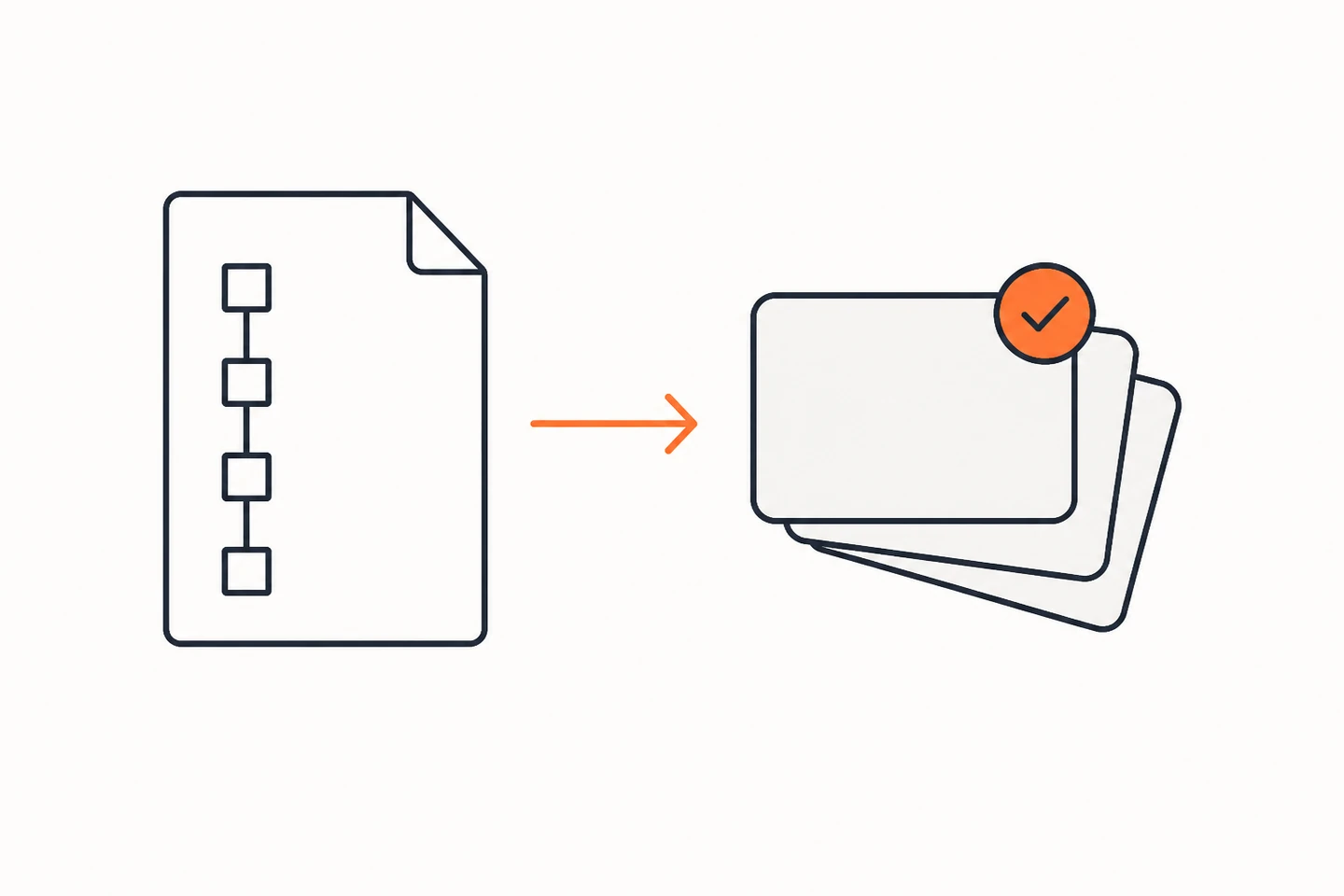
No cleanup pass first. Lorea structures the document into ordered lessons and generates knowledge checks, which immediately exposes any step the SOP never actually explains.
- 03
Share, then fix the gaps the quiz reveals
Wrong answers cluster around badly written steps. Update the source SOP, regenerate in minutes, and the training and the procedure stay in sync permanently.
Outcomes
What converting SOPs to training actually changes
Ordered lessons instead of a wall of text
A 20-page procedure becomes sequenced lessons with a clear beginning and end, so someone can follow it the first time without a guide sitting next to them.
Proof the process transferred
Knowledge checks turn 'I read the SOP' into 'I can answer questions about the SOP'. That difference is the whole point of process training.
Gap detection in your documentation
When the AI cannot generate a sensible question about a step, the step is under-specified. The generated quiz is effectively a free audit of your SOP quality.
Same-day updates
Process changed this morning? Regenerate the course this afternoon. Hand-authored training cannot keep this cadence, which is why it goes stale.
One source of truth
The course is generated from the procedure document, not from a separate summary of it, so there is no second version to maintain or contradict.
Fewer expensive mistakes
Most process failures are not defiance - they are steps someone never knew existed. Checking comprehension catches that before it reaches a customer.
Five rules for SOP training that works
The difference between process training that changes behaviour and process training that gets clicked through.
- 1
One SOP, one course
Do not merge five procedures into a single 'Operations' course. Short one-topic courses get finished, and they stay findable when someone needs to re-check a step next quarter.
- 2
Keep the SOP as the canonical document
The course is a rendering of the procedure, not a replacement for it. Edit the SOP, regenerate the course. Never the other way around, or you will end up with two conflicting versions.
- 3
Put the decision points in the quiz
The valuable questions are not 'what is step three' but 'the customer has already been refunded once - what do you do?'. Judgement calls are where process training earns its keep.
- 4
Train on the exception path too
Most SOPs document the happy path only. If your team improvises whenever something is unusual, the exception handling is tribal knowledge - write it down and include it.
- 5
Re-run the training after every material change
A process change without a training update is how you get two teams doing the same job differently for six months.
Documentation is not the same as training
Writing the procedure down is step one of two, and most teams stop after step one.
There is a comfortable belief in growing companies that once a process is documented, it is handled. The SOP exists, it is linked in the right channel, and if someone gets it wrong that is on them for not reading. In practice, a written procedure produces recognition - people recall having seen the document - without producing recall, which is the ability to reproduce the steps when it matters. The gap between those two is where most operational mistakes live.
This is not a motivation problem, it is a mechanism problem. Reading is passive. Retrieval - being asked a question and having to answer it - is what moves information into usable memory. That is the entire reason SOP training for employees outperforms simply circulating the SOP, and it is why every course Lorea generates ends with knowledge checks rather than a completion button.
The quiz is also a documentation audit
A useful side effect: when a generated question is impossible to answer from the document, the document is incomplete. Teams routinely discover that a critical step exists only in one person’s head - the SOP says “escalate as appropriate” and nobody ever wrote down what appropriate means. Converting the procedure surfaces that immediately, at the cost of a few minutes.
Where to start if you have fifty SOPs
Do not start at the top of the folder. Rank procedures by question volume and consequence: the ones people ask about constantly, and the ones where a mistake is expensive. Convert five of those, then stop and look at the quiz results before doing more. If you are not sure which topics generate the most repeat questions, this guide covers how to find them.
Related workflows
If your source material is a handbook or manual rather than a procedure, use PDF to training course. For new-hire sequencing, see employee onboarding training and new hire training software. If the procedure is regulatory, keep it separate as compliance training from policy so the completion record stays clean. Teams comparing this approach against dedicated process-documentation tools usually land on the Trainual alternative comparison.
Frequently asked questions
How do I turn an SOP into training?
Upload the standard operating procedure and let AI convert it into sequenced lessons with knowledge checks, rather than manually rewriting it as a course. The practical workflow is: pick the SOP that generates the most questions, upload it unedited, share the generated course, then fix whichever steps the quiz results show people misunderstood.
Why do written SOPs fail even when people have read them?
Reading a procedure produces recognition, not recall. People feel familiar with the document but cannot reproduce the steps under pressure, and there is no signal telling you that. Adding knowledge checks converts passive reading into active retrieval, which is what makes a process actually transfer - and it gives you evidence rather than an assumption.
Do I need to clean up my SOPs before converting them?
No, and cleaning up first is usually the wrong order. Convert the messy version, look at which generated questions people fail, and use that to find the steps that were never properly explained. The quiz results tell you exactly where the documentation is weak, which is far more efficient than a blind rewrite.
What kinds of processes work best as courses?
Anything with decision points and consequences: refund and escalation handling, onboarding a client, deploying to production, safety procedures, quality checks, data handling. Purely mechanical tasks with no judgement involved are often better served by a checklist than by training.
How do I keep the training in sync when the process changes?
Because the course is generated from the procedure document, you update the SOP and regenerate. That takes minutes, so training can follow process changes in the same week instead of at the next annual review. This is the main structural advantage over hand-authored course content.
Can I track who completed the process training?
Yes. Each course produces completion records, which is usually enough for internal accountability and for demonstrating that a process change was communicated. For regulated topics that need a formal acknowledgment trail, see the compliance training from policy guide.
Convert your most-asked-about SOP
Pick the procedure your team questions most often, upload it, and see which steps the generated quiz proves nobody actually understood.
Build your first course - freeFree to start. No credit card, no implementation call.
More for teams