How to Stop Repeating the Same Training Questions
If you answer the same onboarding questions every month, that is not a people problem - it is a format problem. Here is the two-week system for finding the questions that repeat and answering each one once, permanently.
- Log for two weeks, then rank by frequency and cost
- Five to eight topics usually cover most interruptions
- Answer once as a course, then reply with the link
- Measure repeat questions per new hire to prove it worked
No credit card. No implementation project. Last updated August 2026.
Short answer
How do you stop answering the same questions at work?
Log every repeat question for two weeks without trying to fix anything yet, then group them and rank the clusters by how often they appear multiplied by the cost of a wrong answer. Answer the top clusters once - as a short course with knowledge checks rather than another message - and from then on reply with the link. Most teams find that five to eight topics account for the majority of repeat questions, which makes this a few days of work rather than a documentation programme.
- Never answer a repeat question only in a DM
- Judgement calls belong in a course, lookups belong in a doc
- Capture tribal knowledge at the moment it is explained
- Track repeat questions per new hire as the success metric
At a glance
- Root cause
- Answers live in conversations and heads rather than in findable, durable form
- First action
- Log every repeat question for two weeks before changing anything
- Typical finding
- Five to eight topics account for most repeat interruptions
- The fix
- Answer once as a course with knowledge checks, then reply with the link
- Success metric
- Repeat questions per new hire, trending down hire over hire
- Common mistake
- Writing a giant wiki instead of the six answers people actually need
The system
Two weeks of logging, then a permanent fix
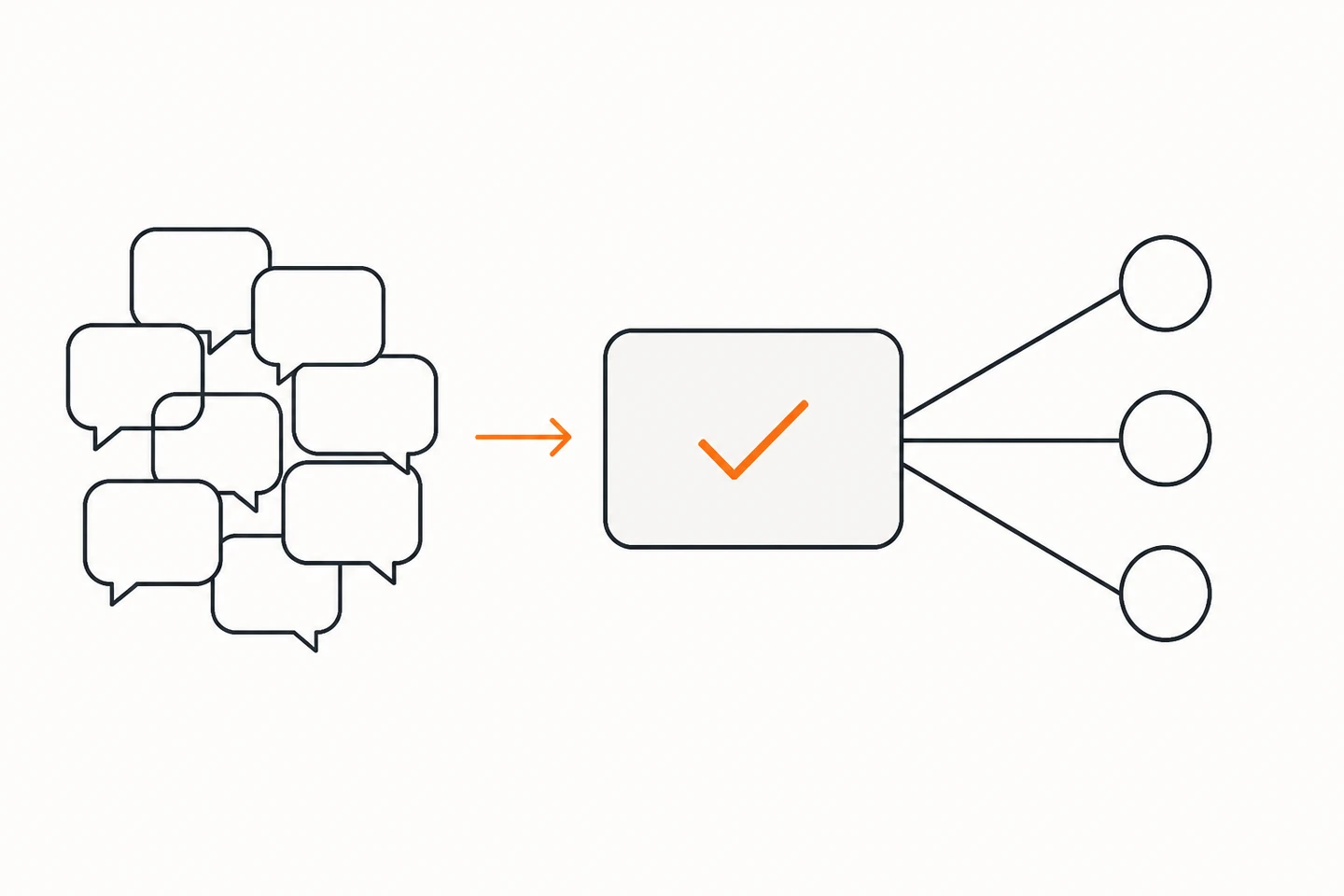
The logging step feels like procrastination and is the reason this works. Without it, you will document what you think people need rather than what they ask for.
- 01
Log every repeat question for two weeks
One line per question, in one place. Do not filter or organise yet. You are collecting evidence, and two weeks is enough to see the pattern clearly.
- 02
Group them and rank by frequency times cost
Clusters emerge fast - usually five to eight topics account for most interruptions. Rank by how often the question appears multiplied by how much damage a wrong answer causes.
- 03
Answer the top clusters once, as a course
Write the answer properly a single time, generate a course from it with knowledge checks, and from then on reply with the link. The next hire starts from the answer instead of from you.
Diagnosis
Six reasons the same question keeps coming back
Identify which one applies before you write anything. The fix is different for each.
The answer exists but is unfindable
It is in a thread, a doc nobody linked, or a wiki page with a name nobody would search for. Findability is a real failure mode, not laziness on the asker's part.
It was told, not learned
Being told something once, verbally, during a busy first week produces almost no retention. If the only delivery was a conversation, expect the question again.
It was never written down at all
The classic tribal knowledge case: a decision rule that lives in one person's head and has never existed in text anywhere.
The documentation stops before the decision
The SOP covers the steps but not the judgement - 'escalate if appropriate' with no definition of appropriate. So people ask, correctly.
Asking you is genuinely faster
If searching takes four minutes and asking takes twenty seconds, people will ask. Fix the speed difference rather than complaining about the behaviour.
The written answer is out of date
Once someone gets burned by stale documentation, they stop trusting all of it and return to asking a human. Trust is expensive to rebuild.
Five habits that make knowledge compound
Individually small. Together they are the difference between a team that gets easier to onboard and one that does not.
- 1
Answer in a durable place, then paste the link
The habit that changes everything: never answer a repeat question only in a DM. Answer it where it can be found, then send the link. Same effort for you, permanent for everyone else.
- 2
Make the answer a course when there is judgement involved
A factual lookup belongs in a document. Anything involving a decision - when to refund, when to escalate, when to say no - belongs in a course with knowledge checks, because you need to know it landed.
- 3
Track question volume as a metric
Count repeat questions per new hire. If hire number four asks as many as hire number one, your programme is not improving. This is the cleanest signal you have.
- 4
Let the wrong quiz answers redirect your effort
Failed questions point at the documentation that is unclear. That is a much better prioritisation signal than guessing which topics need work.
- 5
Set an explicit expectation about asking
People ask out of caution as much as ignorance. Saying plainly 'check the onboarding courses first, then ask me and I'll add it' makes the norm clear without discouraging questions.
Worked example
What the question log usually looks like
A composite from teams of roughly 10 to 50 people. The clustering is remarkably consistent.
| Question cluster | Why it repeats | Right format |
|---|---|---|
| When can we make an exception for a customer? | Judgement rule never written down | Course with scenario questions |
| Who approves this, and up to what amount? | Documented, but not where people look | Short doc, linked from the tool |
| How do I do the weekly reporting task? | Learned once, verbally, in week one | Course generated from the SOP |
| Can I put this data in that tool? | Policy exists but was never trained | Policy course with comprehension check |
| What do we say when a prospect asks about X? | Lives in the heads of two people | Course from sales docs |
| Where is the thing? | Genuine findability problem | One pinned index page |
Note that only one row is solved by writing more documentation. The rest need either a different format or a check that the answer landed.
Repeat questions are a tax on your most constrained people
And the tax rate goes up with every hire.
The reason this matters is not the interruption itself - it is who gets interrupted. Repeat questions route to whoever knows the most, which is almost always the person whose time is most valuable and least substitutable. At three people that is just how a small team works. At fifteen it is a structural problem: one person becomes the read-replica for the whole company’s knowledge, and they cannot be on holiday.
It also caps hiring speed. If every new person requires several hours of a founder’s attention plus weeks of ad-hoc answers, you can only absorb new people as fast as that founder has spare attention. Teams usually experience this as “hiring isn’t working” rather than as a knowledge-transfer failure, which is why it goes unaddressed for a long time.
Why writing more documentation usually does not fix it
The instinctive response is a wiki push. It rarely helps, for two reasons. First, volume hurts findability: a 200-page wiki is harder to search than 20 pages, so question volume can go up. Second, documentation has no feedback mechanism - you never learn whether anyone read it or understood it, so you cannot tell the difference between a topic that is covered and a topic that has landed.
Courses fix the second problem specifically. A knowledge check tells you whether the answer transferred, and the failed questions tell you which explanations are weak. That is why documenting tribal knowledge works better as training than as reference material whenever judgement is involved.
Capture at the moment of explanation
The single most effective tactic: when someone gives a good verbal explanation, capture it right then. Take the message they just typed in Slack, the recording of the call, or five minutes of dictation - and generate a course from that. Asking a busy expert to “write documentation” later has a near-zero success rate. Capturing what they already said has a high one.
Turn the log into a programme
Once you have your ranked clusters, each becomes a module. Feed process questions through SOP to training, policy questions through compliance training from policy, and longer reference material through PDF to training course. Then assemble the result into a proper onboarding programme so the next hire never asks questions one through fifty. The overview lives at Lorea for Teams.
Frequently asked questions
How do I stop repeating the same training questions?
Log every repeat question for two weeks, group them, and rank the clusters by frequency multiplied by the cost of a wrong answer. Then answer the top clusters properly once - as a short course with knowledge checks, not as another DM - and reply with that link from then on. Five to eight topics usually cover the majority of repeat questions, so this is a days-long project rather than a documentation programme.
Why do people keep asking even after I've explained it?
Usually one of three reasons: the explanation was verbal and produced no retention, the written answer exists but is not findable, or asking you is simply faster than searching. None of these are motivation problems. Explaining again produces the same result, which is why the fix has to change the format rather than repeat the delivery.
How do I document tribal knowledge that only exists in someone's head?
Do not ask them to write documentation - that request reliably goes nowhere. Instead, capture the answer at the moment they give it: record the explanation, or take the message they just typed, and turn that into a course. Extract at the point of a real question, when the knowledge is already being articulated.
How do I scale founder knowledge without spending all week writing?
Constrain the scope. You are not documenting everything you know; you are documenting the eight things people keep asking about. Answer each once in a durable place, generate a course from it so comprehension is checked, and let the question log tell you what the ninth topic should be.
Should the answer be a document or a course?
A document is fine for factual lookups - the URL of a dashboard, the address of the office. A course is better whenever judgement is involved or the consequence of getting it wrong is real, because a course lets you verify the answer landed. Being able to see that four out of five people got the escalation question wrong is worth far more than assuming they read the page.
How do I measure whether this is working?
Count repeat questions per new hire, hire over hire. That single number captures whether your training is genuinely compounding. If it is flat, the programme is not absorbing the knowledge - usually because answers are still being given in DMs instead of in durable form.
Answer your most-repeated question once
Take the question you have answered most often this quarter, write the answer properly, and turn it into a course you can link to forever.
Build your first course - freeFree to start. No credit card, no implementation call.
More for teams